The Story
Palazzo Marchesini was built in the 15th century. It stands on Via di Mezzo di San Martino, so called because the street crossed the grounds of the Convent of San Martino. In Roman times, it was a decumanus, one of the city's most important streets.
Like many noble residences of the period, the palazzo had stables on the ground floor, the noble family's apartment on the floor above, and rooms for the household staff on the upper floor. The facade featured a wooden portico, which no longer exists. The noble apartment still features a large hall with a wooden ceiling and a frescoed frieze depicting the arrival of Clement VII for the coronation of Charles V as emperor. The historian Giuseppe Guidicini (Bologna, 1763–1837) wrote: “In the hall there is a frieze depicting the procession held in Bologna in 1530 for the coronation of Emperor Charles V, which differs considerably from what Brucciasorci and Hongherberg depict in their prints.”
Over the centuries, the palazzo was owned by several families and, according to Bolognese custom, changed its name whenever the owning family changed. It was formerly inhabited by the Salicetti family, who were very prominent in Bologna. In 1532, it passed to the Bettini family, which later divided into several branches (see: Fabbri, Fabretti, Bonavolta). When Giovanni Antonio Bonavolta died, the building remained the property of his three daughters, two of whom had taken religious vows. It was then that the Church claimed ownership of the property, since the nuns had taken a vow of renunciation (1661).
In 1662, the Church transferred the building under an emphyteutic lease to the Budrioli family, another well-known Bolognese family. In 1764, Alberto Budrioli appointed Senator Carlo Grassi as his successor to the emphyteutic lease. When the lease ended, the building returned to the Church. In 1772, it was sold to Giacomo Bonazzi and later to Giacomo Panzarasa, who remodeled the facade by removing the old wooden portico facing the street and giving the building an appearance similar to the one it has today.
The palazzo later passed to the Marchesini family, and in 1933 it was acquired by the Guidicini family, who, for reasons that remain undocumented, did not give the building their name. The current owners of the apartment in which the B&B is located are descendants of this family.
Along the wooden staircase leading to the apartment, you can see several fine high-reliefs. Inside the B&B, you can also see a coat of arms and a ceramic high-relief depicting 11 young people with garlands of fruit and flowers.
Like many noble residences of the period, the palazzo had stables on the ground floor, the noble family's apartment on the floor above, and rooms for the household staff on the upper floor. The facade featured a wooden portico, which no longer exists. The noble apartment still features a large hall with a wooden ceiling and a frescoed frieze depicting the arrival of Clement VII for the coronation of Charles V as emperor. The historian Giuseppe Guidicini (Bologna, 1763–1837) wrote: “In the hall there is a frieze depicting the procession held in Bologna in 1530 for the coronation of Emperor Charles V, which differs considerably from what Brucciasorci and Hongherberg depict in their prints.”
Over the centuries, the palazzo was owned by several families and, according to Bolognese custom, changed its name whenever the owning family changed. It was formerly inhabited by the Salicetti family, who were very prominent in Bologna. In 1532, it passed to the Bettini family, which later divided into several branches (see: Fabbri, Fabretti, Bonavolta). When Giovanni Antonio Bonavolta died, the building remained the property of his three daughters, two of whom had taken religious vows. It was then that the Church claimed ownership of the property, since the nuns had taken a vow of renunciation (1661).
In 1662, the Church transferred the building under an emphyteutic lease to the Budrioli family, another well-known Bolognese family. In 1764, Alberto Budrioli appointed Senator Carlo Grassi as his successor to the emphyteutic lease. When the lease ended, the building returned to the Church. In 1772, it was sold to Giacomo Bonazzi and later to Giacomo Panzarasa, who remodeled the facade by removing the old wooden portico facing the street and giving the building an appearance similar to the one it has today.
The palazzo later passed to the Marchesini family, and in 1933 it was acquired by the Guidicini family, who, for reasons that remain undocumented, did not give the building their name. The current owners of the apartment in which the B&B is located are descendants of this family.
Along the wooden staircase leading to the apartment, you can see several fine high-reliefs. Inside the B&B, you can also see a coat of arms and a ceramic high-relief depicting 11 young people with garlands of fruit and flowers.
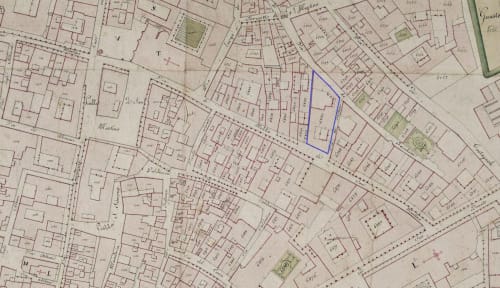
The ancient Via di mezzo of San Martino, from Via Cavaliera (today Via Guglielmo Oberdan) to Via San Donato (today Via Zamboni). Detail from the Gregorian Cadastre (1835). Palazzo Marchesini is highlighted in blue.
Source: State Archives of Bologna, taken from the website https://www.originebologna.com/strade/via-di-mezzo-di-san-martino/
Source: State Archives of Bologna, taken from the website https://www.originebologna.com/strade/via-di-mezzo-di-san-martino/